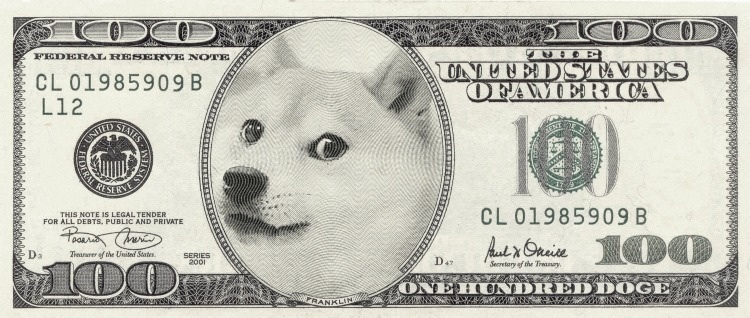
Late April 2026 – Every Dogecoin investor harbors a secret, ultimate fantasy: “$100 per DOGE.” It is whispered in Telegram groups, posted as a rocket emoji on X, and envisioned as the escape from the fiat matrix. Yet, when the math is laid bare, most dismiss it as impossible. A $100 Dogecoin would require a market capitalization of approximately $15 trillion – a figure that rivals the entire above‑ground gold stock and exceeds the GDP of all but the largest nations.
Under current 2026 economic conditions, $100 is mathematically impossible. The global M2 money supply, while expanding, is not yet large enough to allocate such a massive share to a single cryptocurrency without extreme disruption. However, over a multi‑decade timeline, driven by fiat currency collapse, hyperinflation, and Dogecoin’s potential to become the global digital reserve asset, $100 is not only possible – it is a macroeconomic inevitability. This analysis will not offer “moonboy” hype. It will present the brutal math, the two plausible catalyst scenarios (hyperinflation and gold‑flipping), a realistic timeline (2045‑2050), and the stark warning: only spot holders who self‑custody will survive the journey. Leverage traders will be liquidated at every major correction, long before the triple‑digit paradise.
1. The Brutal Math: The $15 Trillion Market Cap
To understand the $100 Dogecoin thesis, we must first accept the sheer scale of the required market capitalization.
- Circulating supply (2026): ~169 billion DOGE.
- Annual emission: ~5.256 billion DOGE (fixed).
- By 2030: ~185 billion DOGE; by 2040: ~232 billion DOGE; by 2050: ~280 billion DOGE.
For a $100 price in, say, 2040 (supply ~232 billion), the market cap would be $23.2 trillion. To be conservative, let’s use a target of $15 trillion (achievable earlier with lower supply). At $100 per coin and approximately 150 billion coins, the market cap would be $15 trillion.
What does $15 trillion represent in real terms?
| Asset / Metric | Approximate Value (2026) |
|---|---|
| Global above‑ground gold stock | ~$15 trillion |
| US GDP (nominal) | ~$27 trillion |
| Global M2 money supply | ~$90 trillion |
| Apple Inc. market cap | ~$3.2 trillion |
| Total crypto market cap | ~$2.5 trillion |
A $15 trillion Dogecoin would be equal to the entire value of all gold ever mined. It would be five times the size of Apple. It would represent 16‑20% of the US GDP. In the context of global M2 ($90 trillion), it would be a 16‑17% allocation – not impossible, but requiring a massive shift in investor preference away from traditional stores of value and toward Dogecoin as a digital commodity.
This is not a 2026 or 2030 target. It is a generational horizon asset. The probability increases as fiat currencies debase and as the global economy digitizes.
🪙 THE $15 TRILLION THRESHOLD (ELITE FINANCIAL DASHBOARD)
Below is a responsive HTML/CSS card comparing a $100 Dogecoin market cap against gold and US GDP, using a deep space black and gold aesthetic.
💰 THE $15 TRILLION THRESHOLD
$100 Dogecoin market cap vs. global assets (2026)
2. Catalyst Scenario A: The Hyperinflation of the US Dollar
A $100 Dogecoin does not necessarily mean that Dogecoin became 1,000x more valuable in real terms. It could simply mean that the US dollar has lost 99% of its purchasing power. This is the hyperinflation scenario.
2.1 The Debt Trap
US national debt has surpassed $35 trillion. Annual interest payments now exceed defense spending. The Federal Reserve’s balance sheet remains elevated, and the political will to cut entitlements or raise taxes is absent. The most likely path is monetization of debt – the Fed printing money to buy bonds, expanding M2 at a rate far beyond GDP growth. In a hyperinflationary environment, a loaf of bread could cost $50, a gallon of gas $30, and a modest house $10 million. In such a world, a $100 Dogecoin would be the equivalent of $0.10 today. The nominal price would rise not because of real demand, but because the measuring stick (the dollar) is melting.
2.2 Historical Parallels
Weimar Germany, Zimbabwe, Venezuela, and more recently Argentina have shown that fiat currencies can lose 99.9% of their value within a decade. In 1923, the German mark went from 4.2 marks per dollar to 4.2 trillion marks per dollar. A loaf of bread cost billions of marks. In such an environment, any scarce, globally recognized asset – gold, Bitcoin, Dogecoin – would see its nominal price explode. Dogecoin’s fixed emission schedule (5.256 billion coins per year) is mathematically tighter than the Fed’s discretionary printing, making it a superior store of value in a hyperinflationary spiral.
We have already begun tracking this loss of fiat purchasing power. See our baseline analysis in [Dogecoin Purchasing Power in 2026: Is DOGE Actually Beating the Cost of Living?].
3. Catalyst Scenario B: Flipping Gold as the Global Digital Reserve
The second, more optimistic scenario is that Dogecoin becomes the undisputed base settlement layer for the global digital economy, absorbing the $15 trillion currently stored in physical gold.
3.1 The Gold Demise
Gold is heavy, expensive to transport, difficult to verify, and impossible to integrate with software. In a world of AI agents, IoT micropayments, and instant cross‑border commerce, gold is obsolete. Dogecoin is digital, divisible, verifiable in seconds, and costs fractions of a penny to move. If the machine‑to‑machine (M2M) economy adopts Dogecoin as its primary currency – and if the X Payments network processes trillions in daily volume – the demand for DOGE as a settlement asset could rival and eventually exceed the demand for gold as a store of value.
3.2 The Asset Flip
Institutional asset allocators currently hold 2‑5% of their portfolios in gold. A shift of half that allocation into Dogecoin would mean over $1 trillion of new capital entering DOGE. Coupled with the supply shock from spot accumulation, a $15 trillion market cap becomes plausible within 20‑30 years. The younger generations already distrust gold; they trust digital assets. As wealth transfers from Baby Boomers to Millennials and Gen Z over the next two decades, the capital will flow.
This requires passing significant psychological checkpoints first. Before $100, we must conquer the immediate milestone mapped out in [The Inevitable $10 Dogecoin: Why a $1.4 Trillion Market Cap is Mathematically Normal by 2030].
4. The Timeline Estimation (2026‑2050)
A $100 Dogecoin is not a 2026, 2030, or even 2035 target. It requires a generational time horizon. Using logarithmic growth curves and the historical adoption rates of transformative technologies (telephones, internet, smartphones), we can project:
- 2026‑2030: Dogecoin establishes itself as the primary payment rail for X and AI agents. Price range $1‑$10. Market cap $150B‑$1.5T.
- 2030‑2040: Hyperinflation or gold‑flipping narrative gains mainstream institutional acceptance. Dogecoin becomes a treasury reserve asset for corporations and nations. Price range $10‑$30. Market cap $1.5T‑$5T.
- 2040‑2050: Complete digitalization of global finance. CBDCs interoperate with Dogecoin. Gold allocation falls to near zero. Price reaches $50‑$100, with market cap $10T‑$23T.
This timeline aligns with the generational wealth transfer – the passing of $84 trillion from older generations to younger ones, who are already crypto‑native. It also aligns with the technological maturity of AI and the metaverse.
5. Why Leverage Traders Will Never See $100
The journey to $100 will include multiple devastating 80% bear markets. Dogecoin has already experienced 90% drawdowns in 2018 and 2022. On the way to $100, expect at least two more 70‑80% corrections. These are not failures; they are the normal clearing mechanisms of a volatile asset entering price discovery.
A 2x leveraged position (common in futures) would be liquidated by a 50% drop. A 5x position would be wiped out by a 20% move. Almost every correction will trigger mass liquidations. The traders who use leverage will be removed from the game, repeatedly. They will sell at the bottom, miss the recovery, and watch from the sidelines.
Only spot holders – those who buy physical Dogecoin, withdraw to cold storage, and refuse to sell – will survive the multi‑decade journey. They will endure the crashes, ignore the fear, and emerge decades later with their full coin count intact. At $100, their patience will be rewarded.
The $100 Dogecoin is not for traders. It is for believers.
6. Conclusion: The Longest Game Wins
The $100 Dogecoin paradigm is not a forecast for 2026. It is a macroeconomic thought experiment grounded in the collapse of fiat currency, the digitization of global value, and the generational shift from physical to digital assets. It requires a $15‑$23 trillion market cap – equal to gold, a fraction of global wealth – and a timeline of 20‑30 years.
It will not happen without pain. The path will include 80% crashes, regulatory battles, and endless mockery from the mainstream media. But for those who understand the mathematics of monetary debasement and the power of a fixed‑supply, decentralized digital currency, $100 is not a fantasy. It is the logical conclusion of a world drowning in debt.
Only one type of investor will see that number: the spot holder who buys, self‑custodies, and holds for decades. No leverage. No trading. No panic. Just patience.
The race to $100 is not a sprint. It is the longest game in financial history. Are you playing?
🔒 Secure your spot Dogecoin for the generational journey with a hardware wallet. See our Best Dogecoin Wallets in 2026 guide.
Not financial advice. This article is for educational purposes. Cryptocurrency investments carry risk. Past performance does not guarantee future results.