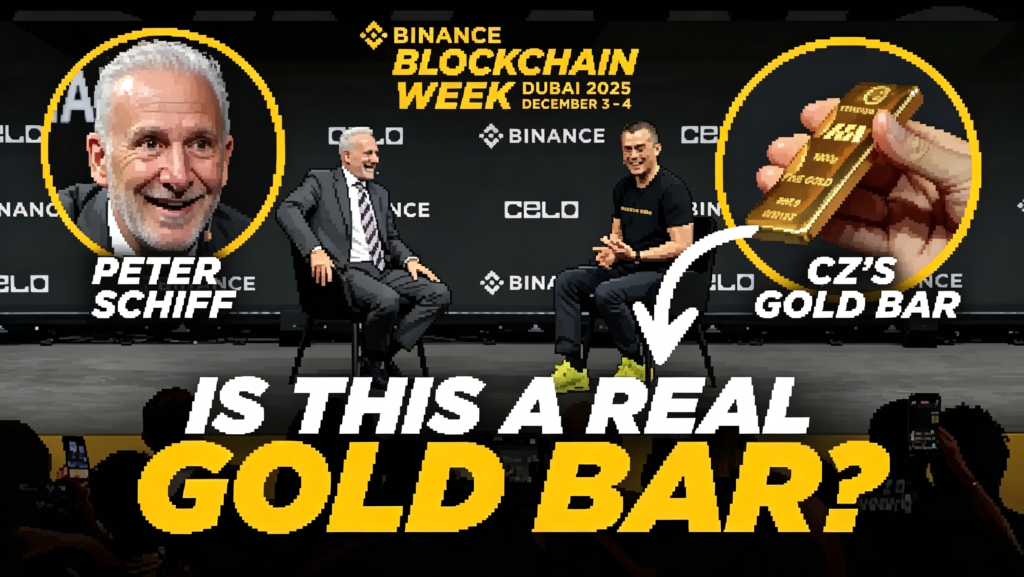
April 2026 – A few years ago, Changpeng Zhao (CZ), the founder of Binance, stood before a camera holding a gleaming gold bar. With the unblinking glare of the lens, he asked a series of questions that still echo across the crypto landscape: “How do you divide this gold bar to buy a coffee? How do you verify that this is 100% real gold and not tungsten‑filled? And how do you carry it across an airport or an ocean?” His point was devastating. Gold – humanity’s oldest store of value – fails the tests of divisibility, verifiability, and portability. It is heavy, easily counterfeited (tungsten‑filled bars), and impractical for everyday transactions.
At the time, CZ used this analogy to champion Bitcoin. Bitcoin, he argued, was digital gold – scarce, verifiable, and portable. And he was right, for that era. But time has moved on. In 2026, a new reality has emerged. Bitcoin has largely settled into its role as “digital gold” – a store of value that is expensive to move and slow to confirm. The original vision of “peer‑to‑peer electronic cash” has been outsourced to faster, cheaper networks. Among those, Dogecoin has quietly ascended to the throne of ultimate money – the best medium of exchange humanity has ever created. This essay will revisit the Gold Bar Dilemma, apply it to Bitcoin, and then prove why Dogecoin is the final evolutionary step: a weightless, cryptographically verifiable, instantly liquid digital cash that can be used by anyone, anywhere, for any amount.
1. The Weight of the Past: Portability & Divisibility
Gold’s first failure is physical weight. A single gold bar weighing 400 troy ounces is worth roughly $1 million at 2026 prices. To transport that value across a border, you need an armored truck, a team of guards, insurance, and customs declarations. The gold itself is a liability; it can be stolen, seized, or lost. Human history is replete with treasure ships sunk by storms and bullion wagons robbed by highwaymen.
Divisibility is an even more crippling flaw. A gold bar cannot be broken into tiny pieces without costly refining. Even gold coins are impractical for micro‑transactions. To buy a $5 coffee, you would need to carry a tiny fraction of a gram – a crumb of gold. But that crumb is easily lost, hard to value, and impossible for a merchant to verify on the spot. Gold is a currency for kings and central banks, not for ordinary people.
Dogecoin solves both problems with mathematical elegance. Divisibility. One Dogecoin is divisible into 100 million atomic units called “dogeshis” (also known as dust). You can send 0.00000001 DOGE or 10,000,000 DOGE with the exact same ease. The coffee can cost 50 dogeshis, and the transaction is as simple as sending an email. Portability. Your entire net worth in Dogecoin – $10 million, $100 million, or even $1 billion – can be stored in a 12‑word mnemonic phrase. That phrase can be memorized, written on a piece of paper, or stamped on a steel plate. It weighs nothing. It fits in your head. You can cross any border with your entire wealth invisible to any scanner or customs officer. This is portability that gold could never achieve.
2. The Tungsten Problem: Cryptographic Verification
Gold’s second fatal flaw is verification. Counterfeit gold bars filled with tungsten (which has a very similar density) have fooled even professional vaults. To truly verify a gold bar, you need to melt it down, X‑ray it, or perform ultrasonic testing – all expensive, time‑consuming, and requiring specialized equipment. A gold coin can be shaved, clipped, or mixed with base metals. The average person cannot trust their eyes alone.
Dogecoin replaces physical metallurgy with cryptographic mathematics. Every Dogecoin is a record on a public, immutable blockchain. When your wallet receives DOGE, the network’s nodes have already verified the signature. The coin cannot be counterfeit. There is no “tungsten Dogecoin.” A merchant needs nothing more than a smartphone with an internet connection to verify your payment instantly. The verification is free, trustless, and global.
This is the “Don’t Trust, Verify” ethos of cryptocurrency. With gold, you must trust the refiner, the assayer, and the person handing you the bar. With Dogecoin, you trust the code – which has been open‑source and audited for over a decade. The entire supply (169 billion DOGE as of 2026) is visible on the blockchain. Every transaction is auditable. No tungsten – only math.
You don’t need a metallurgy lab to prove your wealth is real. Any individual can verify the exact supply on their laptop. Learn how in [Don’t Trust, Verify: How to Personally Audit the Dogecoin Blockchain Supply in 2026].
3. The Bitcoin Bottleneck: Why “Digital Gold” Isn’t Enough
Bitcoin brilliantly solved the Gold Bar Dilemma for the digital age. It is portable (a seed phrase), verifiable (the blockchain), and divisible (satoshis). For this, it earned the title “digital gold” and a market cap of over $1 trillion. But Bitcoin inadvertently created a new bottleneck: it became too expensive and too slow to be cash.
Bitcoin’s average block time is 10 minutes. To be reasonably certain of a transaction, merchants often wait for 3‑6 confirmations – up to an hour. The average fee, even after SegWit and Lightning, often hovers in the $1‑$5 range during congestion. For a $5 coffee, a $3 fee is 60% of the transaction value. This is not cash; it is a settlement layer for large transfers. Moreover, the Lightning Network, while innovative, adds complexity and channel management that is not ready for mainstream daily use.
Dogecoin inherits Bitcoin’s cryptographic strength but discards its sluggishness. Dogecoin’s block time is 1 minute. Merchants can accept 0‑confirmation or wait for 1‑2 minutes with high confidence. The fee is consistently under $0.01 – often a fraction of a cent. Sending 0.1 DOGE or 1,000 DOGE costs the same negligible amount. This makes Dogecoin usable for high‑frequency micropayments: tipping creators, paying for API calls, buying digital artworks, or settling in‑game purchases.
Thus, we arrive at a division of labor: Bitcoin is digital gold – a store of value for inter‑generational savings, rarely moved. Dogecoin is digital cash – the medium of exchange for daily commerce, globally and instantly.
This divergence in utility is exactly why holding both assets makes sense. We explore this dynamic deeply in [Dogecoin vs. Bitcoin (2026): Why DOGE is Better for Daily Payments].
4. Dogecoin: The Ultimate “Digital Cash”
Dogecoin takes the cryptographic perfection of Bitcoin and applies the characteristics of a true cash system: high velocity, low friction, and near‑zero cost. Let us revisit CZ’s three questions through the lens of Dogecoin.
- How do you divide it? Dogecoin is divisible to eight decimal places (dogeshis). You can send one thousandth of a DOGE if you wish. For a $5 coffee at $0.10 per DOGE, you send 50 DOGE. The transaction is seamless.
- How do you verify it’s real? Your wallet checks the blockchain using SPV or a full node. The signature is mathematically unbreakable. No special equipment, no training. A 10‑year‑old can verify a Dogecoin payment on a phone.
- How do you carry it? A 12‑word seed phrase is weightless. Even better, a hardware wallet (like Ledger) fits in a pocket. You can walk across any border with $100 million in Dogecoin, and no one can see it or seize it unless you voluntarily reveal it.
But Dogecoin adds a fourth, implicit virtue that CZ did not mention: speed and finality. Gold takes days to transport and settle. Bitcoin takes hours (or minutes with Lightning, but with channel friction). Dogecoin takes a minute, often less. The network confirms blocks every 60 seconds, and the low fee market means no one is competing to front‑run your transaction. It is the closest thing to digital physical cash.
The upcoming X Payments integration, the RadioDoge project for offline transactions, and the Libdogecoin tooling for developers all point to a future where Dogecoin becomes the invisible plumbing for global value transfer – not hoarded, but circulated. This is what CZ dreamed of, and Dogecoin delivers it better than any other asset.
📊 THE EVOLUTION OF MONEY MATRIX (INSTITUTIONAL GOLD DASHBOARD)
Below is a comprehensive comparison card that evaluates Gold, Bitcoin, and Dogecoin across four critical metrics: Divisibility, Portability, Verifiability, and Transaction Velocity (Speed/Fees).
🏛️ THE EVOLUTION OF MONEY MATRIX
Gold → Bitcoin → Dogecoin (2026)
Poor
Excellent
Excellent
Poor
Excellent
Excellent
Poor
Excellent
Excellent
Poor
Medium
Excellent
5. The Cultural and Economic Argument
Beyond pure metrics, Dogecoin benefits from a community ethos that gold and even Bitcoin lack. The “Do Only Good Everyday” motto has manifested in real charitable donations (water wells, the Jamaican bobsled team) and a culture of tipping. This generosity encourages velocity – the circulation of money – which is exactly what a medium of exchange needs. Hoarding is for gold. Spending is for Dogecoin.
Economically, Dogecoin’s fixed emission of 10,000 DOGE per minute (5.256 billion per year) creates a gentle, predictable disinflation. It is not deflationary like Bitcoin, which encourages hoarding, nor hyper‑inflationary like fiat. It is the Goldilocks monetary policy for a spending currency.
In the physical world, gold is heavy; in the digital world, Dogecoin is light. In the physical world, gold requires trust; in the digital world, Dogecoin requires only mathematics. In the physical world, gold is slow; in the digital world, Dogecoin is fast.
6. Conclusion: The Final Evolution of Money
The Gold Bar Dilemma was a brilliant provocation. It revealed that gold – the foundation of wealth for millennia – is fundamentally flawed as a tool for modern commerce. Bitcoin fixed those flaws but introduced new ones: it became digital gold, too precious to spend. Dogecoin takes the third step: it is digital cash.
Dogecoin is divisible to the atomic, portable to the memory, verifiable by code, and transactable at the speed of the internet with fees low enough to tip a cent. It is the money that CZ was gesturing toward, even if he didn’t name it at the time. It is the money of the internet, the metaverse, and the AI economy. Gold built the past. Bitcoin secured the store of value. Dogecoin fuels the future.
So the next time someone asks you, “Why Dogecoin?” answer with CZ’s own questions: “How do you divide a gold bar? How do you verify it’s real? How do you carry it?” Then hand them your phone and send them 1 DOGE. It will arrive in 60 seconds. They will understand.
🔒 As the ultimate digital cash, Dogecoin deserves the ultimate security. See our Best Dogecoin Wallets in 2026 guide.
Not financial advice. This article is for educational purposes.