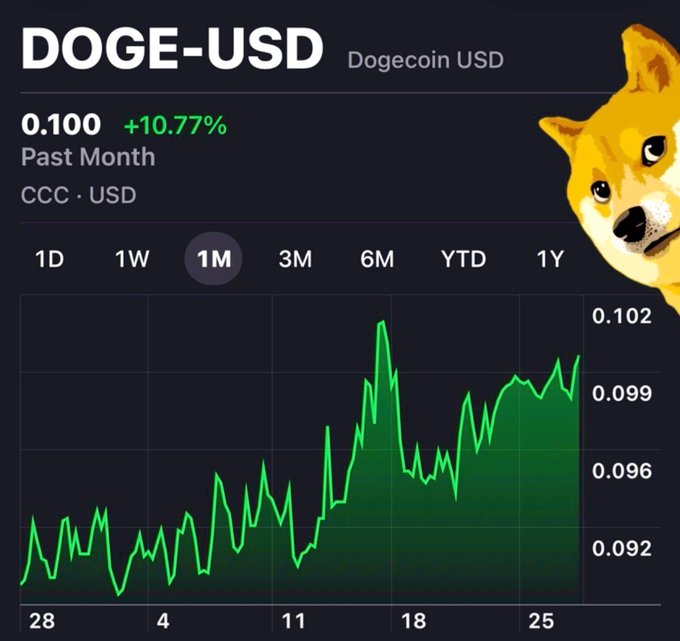
April 2026 – Dogecoin was born as a joke, but it has grown into an infrastructure necessity. The question is no longer “if” Dogecoin will be used for global payments, but “at what price scale can it realistically handle the volume?” A $0.10 Dogecoin cannot settle trillions of dollars in annual transaction flow without catastrophic slippage. A $1 Dogecoin would be better, but still insufficient for the coming wave of X payments, AI micropayments, and global remittances. The mathematical equilibrium – the price at which Dogecoin’s market capitalization is deep enough to serve as a global settlement layer – is $10.
This is not a speculative hype number; it is an infrastructural necessity. For Dogecoin to function as the base settlement layer for 500 million X users, billions of AI agent microtransactions, and a $900 billion remittance market, the network requires a $1.4 trillion market cap. That translates directly to $10 per DOGE. Any lower, and the liquidity depth would be too shallow, causing violent price swings with every large transaction. Any higher, and the network might still work, but $10 is the natural equilibrium given the projected demand and the fixed supply schedule.
This thesis will explain why low prices create a liquidity crisis, why Wall Street’s derivatives casino cannot provide real utility, why institutions are accumulating spot Dogecoin, and the timeline to $10 by 2030. $10 is not the moon; it is the launchpad.
1. The Liquidity Problem at Low Prices
Liquidity depth – the amount of an asset available at prices close to the market rate – is critical for any medium of exchange. Imagine Dogecoin at $0.10 with a market cap of $15 billion. The daily order book depth on major exchanges might be $50‑100 million at the top few price levels. If X (Twitter) were to process 100 million Dogecoin transactions per day – each averaging, say, $5 – the total daily flow would be $500 million. That is larger than the available liquidity at stable prices. The result: slippage, where each transaction moves the price significantly. A merchant accepting Dogecoin would see wildly fluctuating settlement values. The system would be unusable for commerce.
1.1 The Slippage Threshold
For a currency to function as a global medium of exchange, the daily transaction volume should be a small fraction of the total market cap – ideally less than 1% to avoid noticeable slippage. If daily Dogecoin transaction volume reaches $10 billion (a modest estimate for global remittance and social media tipping), the required market cap is:
Market Cap ≥ Daily Volume ÷ 0.01 = $10B / 0.01 = $1 Trillion.
A $1 trillion market cap corresponds to a DOGE price of approximately $7. $10 gives a $1.45 trillion market cap, providing a comfortable buffer. At current $0.10, the market cap would be less than 1% of that needed, making any large‑scale commerce impossible.
1.2 The X Payments Catalyst
X is expected to launch Dogecoin payments by late 2026. With 500 million monthly active users, even a small fraction using DOGE for micro‑tipping creates billions in daily volume. The only way to absorb that volume without extreme volatility is a price that brings market cap into the trillion‑dollar range. The market will naturally adjust upward as demand meets the fixed supply. $10 is that equilibrium.
📊 GLOBAL LIQUIDITY SETTLEMENT CARD
Below is a responsive HTML/CSS card that visualizes the required market cap for Dogecoin to process global payment flows without severe slippage.
🌍 GLOBAL LIQUIDITY SETTLEMENT (DOGE @ $10)
Required market cap to absorb global payment volume without slippage
2. Rejecting the Derivatives Casino
Wall Street has flooded the market with Dogecoin futures, perpetual swaps, and leveraged tokens. These instruments create enormous paper volume that does not represent real demand for the underlying coin. A trader can buy $1 million worth of “paper DOGE” on a futures exchange without affecting the spot price at all. This artificial liquidity creates a false sense of depth, but it does not help a merchant settle a payment.
2.1 Utility Requires Native Settlement
You cannot tip a creator with a futures contract. You cannot pay for a coffee with a leveraged token. You cannot remit money to your family using a derivative. Global commerce requires native, spot Dogecoin – UTXOs on the Dogecoin blockchain that represent actual value. Derivatives are casino chips; they do not circulate in the real economy.
2.2 The Separation of Price and Utility
The derivatives market can depress or inflate the spot price temporarily, but eventually, real demand overwhelms paper manipulation. When X launches Dogecoin payments, millions of users will need to acquire spot DOGE. They will buy on exchanges and withdraw to their wallets. This spot demand will drain exchange liquidity, forcing the price upward to the level where market cap matches the required liquidity depth – which is $10. The derivatives market will be left behind, as it always is in a supply shock.
Paper is for gambling. Spot is for living.
3. Institutional Spot Accumulation
Forward‑looking institutions are not trading Dogecoin; they are accumulating it. Family offices, corporate treasuries, and even some sovereign wealth funds have realized that Dogecoin is not a speculative asset but a necessary infrastructure component for the coming digital economy.
3.1 The Balance Sheet Hedge
In 2026, several public companies have announced that they hold Dogecoin as a treasury reserve asset. They are not trading it for short‑term profit; they are hoarding spot DOGE because they understand the $10 liquidity requirement. When X payments go live, these institutions will not sell; they will use their DOGE to settle cross‑border transactions, avoiding the legacy banking system. Their spot accumulation further tightens the available supply.
3.2 The “Sticky” Supply
Every coin that is moved to cold storage and held for years is a coin removed from the liquid supply. As more institutions and individuals adopt this strategy, the available float on exchanges shrinks. The same daily demand (from X users, AI agents, remittance providers) must be met by a smaller and smaller pool of available DOGE. The price must rise to balance supply and demand. $10 is that equilibrium.
These institutions are putting Spot Dogecoin directly on their balance sheets to hedge against fiat failure. Learn how they do it in [The Corporate Dogecoin Standard: Why Small Businesses Are Holding DOGE in Treasury].
4. The Timeline to $10 (2026‑2030)
The path to $10 is not a straight line, but the macro forces are inexorable. Here is a plausible adoption curve:
- 2026 (Late): X launches Dogecoin payments. Early adopters begin tipping and making small purchases. Daily volume increases to $500 million. Spot price rises to $0.50‑$1.00 as retail and institutions front‑run the adoption.
- 2027: AI agent microtransactions go mainstream. AI assistants pay for data APIs, compute time, and premium content in Dogecoin. Daily volume reaches $2 billion. Price enters the $2‑$4 range.
- 2028: Global remittance platforms integrate Dogecoin as a settlement rail. Migrant workers start using DOGE to send money home, bypassing Western Union fees. Daily volume surpasses $5 billion. Price consolidates between $4 and $7.
- 2029‑2030: Mainstream merchant adoption and central bank digital currency (CBDC) interoperability drive daily volume to $15‑20 billion. The market cap reaches $1.5 trillion. Dogecoin settles into the $8‑$12 range, with $10 as the long‑term equilibrium.
Throughout this journey, the only way to capture the full upside is to accumulate spot DOGE and hold through the volatility. Derivatives traders will be shaken out at every correction. Spot holders who withdraw to cold storage will ride the wave.
5. Conclusion: $10 is the Beginning
Dogecoin was never meant to be a speculative plaything. It was designed to be a fast, low‑cost, decentralized currency for the internet. That dream is now becoming reality, but the price must rise to meet the demands of global commerce. $10 is not a hype target; it is the mathematical equilibrium required for Dogecoin to function as a global settlement layer without crippling slippage.
The market will get there through the natural forces of supply and demand. But it will only happen if participants buy spot and hold. Every leveraged trade, every derivative, every “paper” transaction is a distraction. The real value lies in the coins you own outright, stored in your own wallet.
$10 is not the moon. It is the launchpad. From there, Dogecoin can finally fulfill its destiny as the people’s money. The path is clear. The math is inevitable. The only question is whether you will be holding spot when the world arrives.
🔒 Secure your spot Dogecoin for the global liquidity settlement with a hardware wallet. See our Best Dogecoin Wallets in 2026 guide.
Not financial advice. This article is for educational purposes. Cryptocurrency investments carry risk.