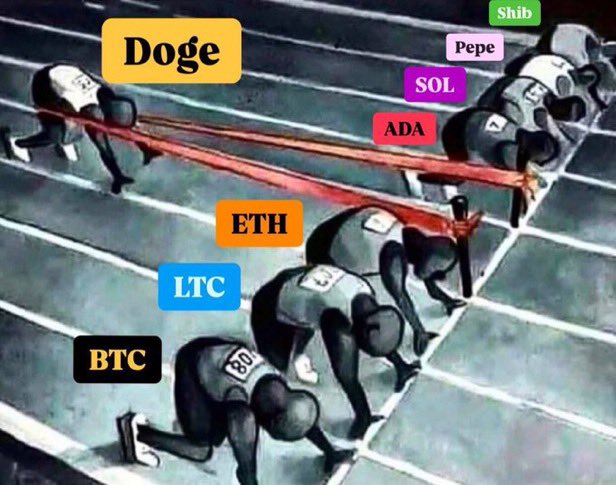
August 2026 – Santa Clara, Silicon Valley – You know the meme. A race track. BTC, ETH, SOL, and PEPE are all lined up at the starting line. But DOGE is nowhere to be seen—until you notice the massive red rubber band stretched to its absolute limit, with the Doge runner pulled far, far back, ready to snap forward and blast past them all.
This isn‘t just a funny picture. It’s the most accurate visual representation of Dogecoin‘s macroeconomic behavior on the market today.
Dogecoin does not run with the pack. It runs last — and that is precisely what makes it so dangerous. While other coins pump on hype, DOGE lags, consolidates, builds tension, and waits. It intentionally falls behind to build up liquidity and kinetic energy, before unleashing a violent, market‑bypassing Slingshot Effect that leaves every other asset in the dust.
The further you pull the rubber band back, the further it flies. And right now, in August 2026, that rubber band is stretched tighter than it has been in years.
1. The Famous Meme Explained: Why Lagging is a Feature, Not a Bug
Let‘s be clear: Dogecoin’s lagging price action is not a sign of weakness. It is a structural necessity.
In every major crypto cycle, Dogecoin follows a predictable pattern: Bitcoin leads, Ethereum follows, mid‑caps run, and then—finally—Dogecoin explodes. While impatient traders watch PEPE or SHIB pump and FOMO into the next shiny token, the smart money is quietly accumulating DOGE at its lowest levels, waiting for the rubber band to snap.
The Slingshot Effect is the payoff for patience. When Dogecoin finally breaks out, it doesn‘t just move—it obliterates resistance levels. In 2017, DOGE surged over 5,850% after a prolonged consolidation. In 2021, it rallied over 21,000% after years of compression. The pattern is clear: the longer the consolidation, the more violent the breakout.
Today, in August 2026, Dogecoin is trading around $0.09, still 88% below its all‑time high. But analysts are already spotting the same long‑term technical setup that preceded both the 2017 and 2021 manias. The rubber band is stretched. The question is not if it will snap—but when.
2. The Technical Analysis: Spring Compression and the Bollinger Squeeze
The Wyckoff Spring: Trapping the Bears
Richard Wyckoff‘s accumulation model is one of the most reliable frameworks for understanding market bottoms. In a Wyckoff accumulation, price goes through distinct phases: a selling climax, a secondary test, a spring (where price briefly dips below support to trap bears), and finally, a markup phase.
In June 2026, analysts identified Dogecoin entering Phase C of a Wyckoff accumulation pattern, where a “spring” often shakes out weak holders before price attempts a stronger recovery. By mid‑June, DOGE had completed the Spring and stepped into Phase D, positioning for markup.
This is textbook accumulation behavior. The spring is designed to panic retail into selling their bags at the worst possible moment, transferring coins from weak hands to strong hands. Those who hold through the spring are rewarded with the markup that follows.
The Bollinger Band Squeeze: Volatility at Historic Lows
Perhaps the most telling technical signal is the extraordinary contraction of Bollinger Bands on Dogecoin‘s weekly chart. In June 2026, the gap between the upper and lower bands shrank to just 35%—a level of volatility compression not seen since 2023.
On August 10, 2026, DOGE flatlined at $0.070006, with all three Bollinger Bands converging into one of the tightest squeezes ever seen on a major‑cap crypto. When Bollinger Bands constrict to this degree, it signals that volatility has been drained from the market. And when volatility disappears, it doesn‘t stay gone—it explodes back.
The historical precedent is clear: Bollinger Band squeezes on Dogecoin have preceded 15‑20% directional moves. The tighter the squeeze, the more violent the expansion.
These long periods of low volatility shake out impatient retail traders. We deeply analyzed this accumulation psychology in The ‘Boring’ Phase of Crypto: Why Months Without News Are When Dogecoin Millionaires Are Made.
3. Capital Rotation: Why Dogecoin Always Runs Last
The crypto market operates on a predictable liquidity cycle:
- Fiat → Bitcoin – Institutional money flows into BTC first.
- Bitcoin → Ethereum – Profits rotate into ETH.
- Ethereum → Mid‑Caps – Capital flows into SOL, ADA, and other layer‑1s.
- Mid‑Caps → Dogecoin – The final stop. The biggest, most explosive gains.
Dogecoin is the last stop on the capital rotation highway. It waits for Bitcoin and Ethereum investors to secure their profits. Those massive profits then look for high‑beta plays, flowing directly into Dogecoin all at once. This is why DOGE always runs after everything else has already moved.
The data confirms the pattern:
Historical Slingshot Breakouts
| Cycle Year | Days Spent in Consolidation | Max Drawdown (The Pullback) | Subsequent Breakout % |
|---|---|---|---|
| 2017 | ~1,000+ days (2014–2017) | ~90% | +5,850% |
| 2021 | ~900+ days (2018–2021) | ~95% | +21,457% |
| 2026 | ~700+ days (2021–present) | ~90% (from $0.73 to $0.06) | ? (projected: 3,800%+ to $2.82) |
The 2026 cycle is following the exact same rhythm as 2017 and 2021. DOGE has been consolidating since its 2021 peak, experiencing a 90% drawdown—just like previous cycles. The only difference is that this time, the consolidation is happening at a much higher price level, which means the eventual breakout could be even more explosive.
As one analyst noted, Dogecoin‘s current price structure is repeating the same multi‑cycle pattern that preceded breakout phases in both the 2017 and 2021 cycles. The base is being built. The slingshot is being pulled back.
4. The Danger of “Jumping Off the Slingshot”
The biggest mistake investors make during a slingshot setup is jumping off too early.
You wait for months. You watch PEPE pump 200%. You watch SHIB run. Your DOGE sits there, doing nothing. Frustration builds. You think: “I‘ll just sell my DOGE, catch this PEPE pump, and buy back into DOGE later.”
This is the trap. Selling at maximum tension guarantees you will miss the launch.
When you sell your DOGE to chase another coin, you are not just losing your position—you are becoming exit liquidity for that other coin‘s run. The pump you chase will reverse, and you will be left holding a bag while DOGE finally snaps and leaves you behind.
The psychology is understandable. Delayed gratification is one of the hardest skills in investing. But the data is clear: every single time Dogecoin has entered a prolonged consolidation phase, the eventual breakout has rewarded those who held with life‑changing gains.
Chasing shiny new tokens often leads to permanent capital loss. Remind yourself why the original king holds value by reviewing Dogecoin vs. New Meme Coins (Pepe, Bonk, WIF): Why the Original King Still Rules.
5. How to Position Yourself for the Release
The slingshot release happens fast. When Dogecoin breaks out, it does not crawl—it rips. In 2021, DOGE went from $0.05 to $0.73 in a matter of weeks. In 2017, it surged over 5,000% in months.
You cannot wait for the news to buy. By the time the mainstream media reports on the breakout, the move is already halfway done.
The Slingshot Tension Indicator
Below is a visual representation of the current market tension. The rubber band is stretched to its limit. The kinetic energy is building. The breakout is imminent.
🎯 SLINGSHOT TENSION INDICATOR
Dogecoin: Kinetic Energy Accumulation Tracker
Current Phase🔴 EXTREME TENSION (Volatility Squeeze)
Bollinger Squeeze⚡ Kinetic Energy: 98%Wyckoff Spring
Current Price
$0.09
Bollinger Width
~35%
Historic low
Breakout Probability
IMMINENT
Historical precedent
● Wyckoff Phase C → D transition detected ● Bollinger Band width at 2023 lows ● Historical breakouts: +5,850% to +21,000%
How to Position Yourself
- Accumulate on weakness. The slingshot doesn‘t launch in a straight line. Use pullbacks to add to your position.
- Set a wide stop. Volatility cuts both ways. If you are using leverage, keep it low—1–2x maximum.
- Have a target. Know where you are taking profits. The slingshot can overshoot, but it can also reverse.
- Be patient. The rubber band is pulled back. It will release. The only question is when.
Once the rubber band snaps and you are sitting on massive gains, human greed will tell you not to sell. Defeat this emotion by strictly following The Ultimate Dogecoin Exit Strategy: How to Cash Out Your DOGE in 2026 Without Losing a Fortune.
6. Conclusion: Patience is the Ultimate Alpha
The slingshot effect is not a theory. It is a documented, repeatable pattern that has played out in every major Dogecoin cycle. The 2017 breakout, the 2021 breakout—both were preceded by long, painful consolidations that shook out impatient traders and rewarded those who held.
In August 2026, Dogecoin is sitting at the tightest Bollinger Band squeeze in years. Wyckoff accumulation is in its final phases. Capital rotation is inevitable. The rubber band is stretched to its absolute limit.
The further you pull the rubber band back, the further it flies.
Patience is the ultimate alpha. The slingshot is loaded. The target is set. All that remains is the release.
Not financial advice. This article is for educational purposes. Cryptocurrency markets are highly volatile. Past performance does not guarantee future results.