
The Origin (2013): A Joke That Barked Back
The story of Dogecoin begins not with a grand financial vision, but with a lighthearted jab at the crypto world. In late 2013, as the market swelled with new, self-serious cryptocurrencies, Adobe marketer Jackson Palmer and IBM software engineer Billy Markus decided to create the “anti-Bitcoin”. Their goal was simple: to mock the speculative frenzy and make digital currency feel more accessible and fun.
The spark was an internet meme—a picture of a Shiba Inu dog, known as “Doge,” accompanied by broken, colorful Comic Sans text. Palmer bought the domain Dogecoin.com as a joke, and Markus saw it and decided to bring the idea to life. Using Litecoin’s code as a base, he replaced “Litecoin” with “Dogecoin” and “mining” with “digging”. In just three hours, a global phenomenon was coded into existence. They launched it without “pre-mining” any coins for themselves, a pure act of satire that would become a cornerstone of its community-first ethos. They thought the joke would fade in weeks. They were wonderfully wrong.
The Community Era (2014): The Golden Age of “Do Only Good Everyday”
What happened next was magical. Dogecoin didn’t attract hardcore speculators first; it attracted a community. On platforms like Reddit, people began tipping each other small amounts of DOGE for creating funny posts or helpful comments. This culture of micro-tipping and generosity laid the foundation for something extraordinary: the unofficial motto, “Do Only Good Everyday” (D.O.G.E.).
The community quickly rallied around charitable causes, proving that a “joke” currency could have a real-world impact:
- The Jamaican Bobsled Team: In early 2014, the community raised $30,000 worth of DOGE to help the team travel to the Sochi Winter Olympics.
- Doge4Water: Later that year, they raised another $50,000 to fund the construction of clean water wells in Kenya.
- NASCAR #98 “The DogeCar”: In perhaps the most surreal moment, fans pooled $55,000 in DOGE to sponsor driver Josh Wise. Jackson Palmer, watching the #98 car roar around the track covered in the Doge meme, described the feeling as “crazy,” “surreal,” and a “reality check”.
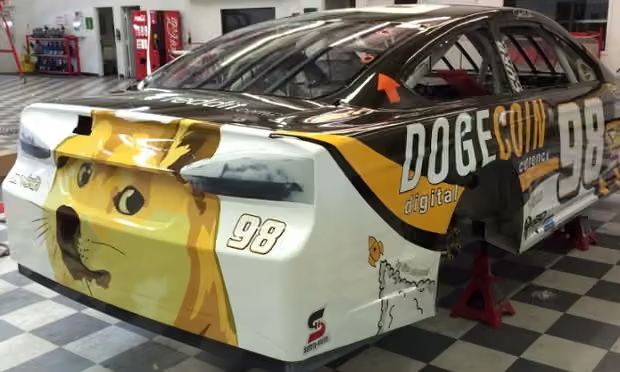
NASCAR #98 “The DogeCar”
This era defined Dogecoin’s soul. It wasn’t about price; it was about people, laughter, and collective action.
The Quiet Years (2015-2019): The Faithful Keep the Flame Alive
After the whirlwind, the founders stepped back. Overwhelmed by the community’s shift toward serious investment and facing internal controversies, both Palmer and Markus left the project. Billy Markus sold all his coins, using the proceeds to buy a used Honda Civic. The price stagnated, and to the outside world, Dogecoin seemed like a passing fad.
But the Shibe Army never disbanded. On forums and social media, the core community kept the spirit alive. They maintained the network, continued to use DOGE for tips and small transactions, and held onto the culture of kindness. This period of quiet resilience proved that Dogecoin was more than its creators or its price—it was a self-sustaining idea.
The Explosion (2020-2021): To The Moon!
The dormant volcano erupted in 2020. The catalyst was Elon Musk, the “Dogefather,” who began tweeting about the coin. His posts, combined with a wave of retail investor enthusiasm on platforms like Reddit’s r/WallStreetBets and TikTok, ignited a historic bull run.
In May 2021, Dogecoin reached its all-time high, fueled by a frenzy of mainstream attention and Musk’s appearance on Saturday Night Live. While the subsequent volatility was brutal, it cemented DOGE’s place in the cultural and financial zeitgeist. It was no longer just a community token; it was a top-ten cryptocurrency with a market cap in the tens of billions.
The Maturity (2022-2026): From Meme to Mainstream Infrastructure
Surviving the hype cycle was Dogecoin’s next great test. And it passed. Through the market cycles of the early 2020s, Dogecoin shed its image as a purely speculative asset and began solidifying real utility.
- Merchant Adoption: Major companies, led by figures like Mark Cuban, began accepting DOGE for payments.
- Foundation Revival: The Dogecoin Foundation was re-established in 2021, bringing structured guidance to the project’s future.
- The Utility Standard: By 2026, Dogecoin has matured into a standard for internet tipping and small-value transactions. Its fast block time (about 1 minute) and extremely low fees make it perfect for what it was always good at: moving small amounts of value between people, seamlessly and cheerfully. The dream of being a “people’s currency” is closer to reality than ever before.
Why Dogecoin Will Never Die: It’s About the People
Dogecoin’s technology is robust but not revolutionary. Its supply is inflationary, not scarce. According to traditional finance, it shouldn’t work. Yet, here it is, over a decade later.
The secret is that Dogecoin’s value isn’t stored in its code; it’s stored in its community. It’s a story of resilience, humor, and goodwill that millions have chosen to be part of. It’s the shared memory of sending a bobsled team to the Olympics and the ongoing practice of tipping a creator for a great post. In a digital world often dominated by cynicism and greed, Dogecoin’s persistent, joyful, and generous community is its ultimate, unbreakable foundation.
Want to be part of this ongoing history? It starts with joining the community. Learn how to get your first Dogecoin safely with our guide on [How to Buy Dogecoin Safely].
Curious what the future chapters might hold? Explore the possibilities in our [Dogecoin Price Prediction 2026-2030] analysis.